

jxtz.over-blog.com/
14 Février 2021

These include which Amazon S3 buckets the user can access, what portions of each Amazon S3 bucket are accessible, and what permissions the user has (for example, PUT or GET). To set access, you create a resource-based IAM policy and an IAM role that provides that access information. WinFTP Pro – a multifunctional FTP, SFTP, WebDAV, Amazon S3 and SCP client for Windows 10. WinFTP Pro provide secure file transfers between a local and a remote computer by utilizing the Secure Shell (SSH) technology. It also supports the SCP and SFTP protocol. WinFTP Pro also provides basic file management and synchronization functionality.
By default, Plesk stores backups on the server. However, this presents arisk. If the server's hard disk fails, you can lose both your websitedata and your backups. To avoid this, we recommend storing backups inremote storage. This topic explains how to configure remote storage forbackups in Plesk.
You can configure the following types of remote storage:
Storing scheduled backups in a remote cloud storage is a premiumfeature. Ask your hosting provider to unlock it or store backups inthe server storage, in the FTP storage, or use manual backups.
You can configure more than one remote storage, but you can only haveone S3-compatible storage configured at a time. For example, you canconfigure both Amazon S3 Backup and Google Drive Backup, but not AmazonS3 Backup and DigitalOcean Spaces.
When creating backups, you can only use one remote storage at a time. Ifyou want to store backups in more than one remote storage, create abackup once for every remote storage you want to use.
To configure the FTP storage:
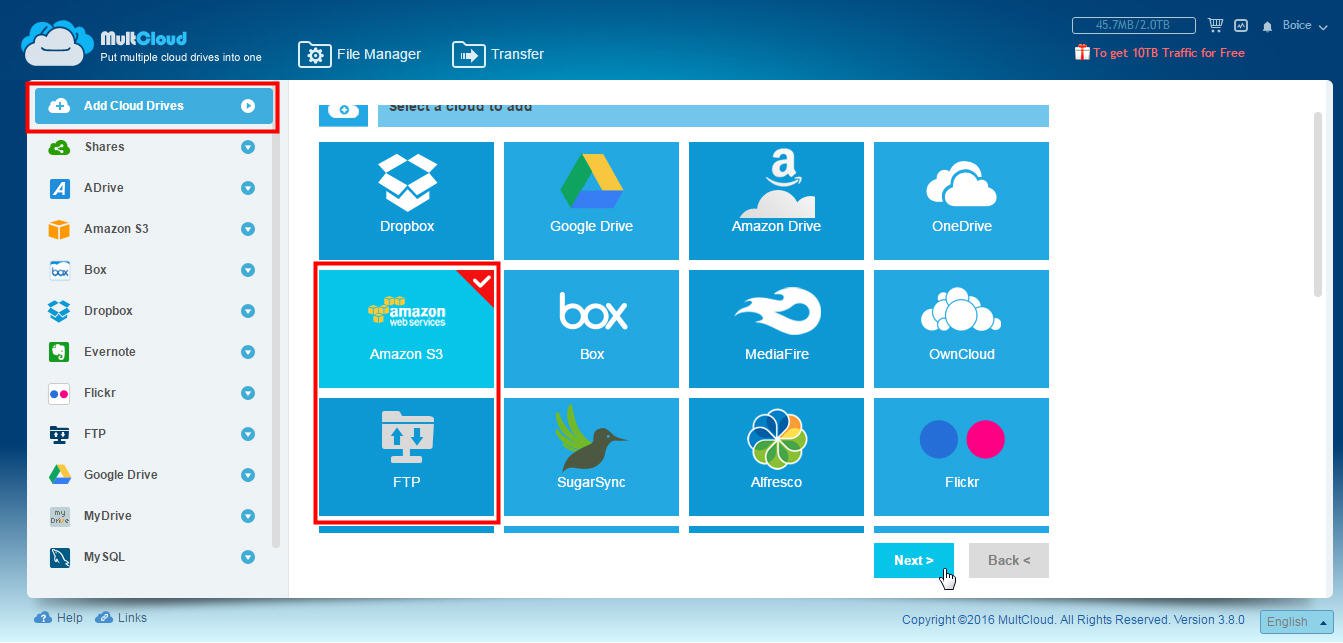

The FTP storage is configured. Now you can select it when creating amanual or scheduled backup.
To configure the Amazon S3 Backup storage, you need an IAM user account.We call this account restricted because it has a limited number ofpermissions necessary for the Amazon S3 Backup extension to operate.
The extension can automatically create a restricted IAM user account, oryou can do it manually.
To configure the Amazon S3 Backup storage automatically:
To configure the Amazon S3 Backup storage manually:
s3:CreateBucket, s3:ListBucket,s3:GetObject, s3:PutObject, s3:DeleteObject,s3:ListMultipartUploadParts, s3:AbortMultipartUpload, ands3:ListAllMyBuckets permissions to the account.The Amazon S3 Backup storage is configured. Now you can select it whencreating a manual or scheduled backup.
To configure the Google Drive Backup storage:
The Google Drive Backup storage is configured. Now you can select itwhen creating a manual or scheduled backup.
If you want to store backups in Google Drive storage associated with adifferent Google account, go to Tools & Settings > BackupManager > Remote Storage Settings > Google Drive Backup andclick the 'Log out' link.
This will disconnect the currently connected Google Drive Backupstorage. You can then connect a different one following the steps above.Disconnecting the Google Drive Backup storage does not remove the Pleskbackups stored in it. If you reconnect it at a later date, you will seethe stored backups in the Backup Manager and will be able to restorethem.
To configure DigitalOcean Spaces Storage:
The DigitalOcean storage is configured. You can now select it whencreating a manual or scheduled backup.
A number of services offering remote storage use APIs compatible withAmazon S3. We call them S3-compatible. Of those, Plesk explicitlysupports DigitalOcean, Minio, and OpenStack.
You can try configuring any other S3-compatible storage in Plesk, butthere is no guarantee that it will work as expected. You can use theAWS Command Line Interface (AWS CLI)to check an S3-compatible storage for compatibility with Plesk. If youcan upload or download a file from the storage via the AWS CLI, you canprobably use the storage with Plesk.
To configure an S3-compatible storage:
The S3-compatible storage is configured. http://mqdlnim.xtgem.com/Blog/__xtblog_entry/19449798-step-7-software-free-download#xt_blog. You can now select it whencreating a manual or scheduled backup.
To configure the Microsoft OneDrive Backup storage:
The Microsoft OneDrive Backup storage is configured. You can now selectit when creating a manual or scheduled backup.
If you want to store backups in OneDrive storage associated with adifferent Microsoft account, go to Websites & Domains > BackupManager > Remote Storage Settings > Microsoft OneDrive Backupand click the 'Log out' link.
This will disconnect the currently connected OneDrive Backup storage.You can then connect a different one following the steps above.Disconnecting OneDrive Backup storage does not remove the Plesk backupsstored in it. If you reconnect it at a later date, you will see thestored backups in the Backup Manager and will be able to restore them.
You can secure backups stored in remote storage with a password. Doingso encrypts the passwords stored in the backup, such as mail accountpasswords or database user passwords. Even if a third party obtains abackup, they will not be able to get the passwords stored inside.
When you restore a password-secured backup, you need to provide thepassword. If you cannot, all passwords stored in the backup aregenerated randomly.
To secure remote storage backups with a password:
Configure at least one remote storage.
Go to Tools & Settings > Backup Manager > Remote StorageSettings. The section 'Backup security settings' has becomeavailable.
https://trends-free.mystrikingly.com/blog/recoverit-7-3-0-13-comprehensive-data-recovery-suite. Under 'Password Protection', click the 'change' link next to'Disabled'.
Dupin 2 12 3 – manage duplicate itunes tracks version. Select the 'Use password protection (recommended)' checkbox. Fill gaps between walls.
Type in the password in the corresponding fields.
Click OK.
Now all backups stored in remote storage will be secured with thepassword.
Amazon S3 online storage is an inexpensive place for any amount of data. After registration via the above link you can start storing data right away. There is no monthly fee and there are only low fees for storage used and Gigabytes transferred.
S3 can be specified as the left or right side of the synchronization. When using S3 for backup, it is recommended to use the right side for S3.
Click on the Internet… (world icon) button to configure the Amazon S3 access. In the dialog box that appears, please change the protocol from FTP to Amazon S3. Specify the desired bucket name and your S3 credentials.
Buckets
Amazon S3 storage is divided into units called buckets. Each customer can create 100 buckets. However, you must find bucket names that no other customer has chosen yet. Within a bucket, you can store any number of folders and files.
Credentials
On the Internet Protocol Settings dialog, you can enter your S3 access details. You can retrieve the credentials on the Amazon S3 web site. You will probably want to choose the options Save Access ID and Save Secret Key.
Preserving Timestamps, Versioning
If you would like to preserve your files' timestamps on Amazon S3, you should choose the option Filename Encoding. This also enables you to using versioning and keep multiple versions of each file in the backup storage.
There's a separate documentation page on Versioning and Filename Encoding.
Compression / Zipping / Encryption
The files can also be zipped and encrypted. You will find these options on the Zip tab sheet. When combining compression with filename mangling, you must compress each file into a separate Zip file. So you should only use the two upper checkboxes on the Zip tab sheet.
Speeding things up with the Destination Cache
You can speed up reading the file list with the setting 'Cache Destination File List…'. This can be used when you are uploading to a remote folder only from one local PC by doing regular backups.
Restoring Files From Backup Storage
Please read this documentation on performing a restore.
Activision mw2 support. Alternative Hosts
You can use alternative servers, for example specify this as your bucket name: bucketname@cs.hosteurope.de.


/image%2F6312104%2F20210221%2Fob_6a75db_jw-library-2018.jpeg)
/image%2F6312104%2F20210221%2Fob_be1f12_www-jw-org-jehovahs-witnesses.jpeg)
/image%2F6312104%2F20210221%2Fob_74834c_py-co-pay-wikipedia.jpeg)
/image%2F6312104%2F20210221%2Fob_4cddd9_my-facetime-camera-wont-work.jpeg)